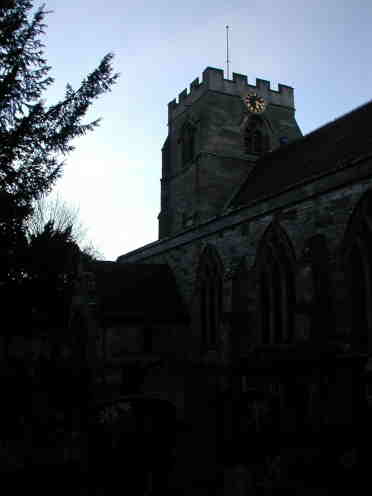

St Peter & St Paul


History of the village and early church

It is very difficult to give an exact date for the building of the church, but judging from the general architecture of the chancel with its lancet windows, it can be fixed approximately at the end of the 12th century.

The church was built through the efforts and generosity of the Abbess of Barking Abbey, and was intended to provide for the spiritual needs of the tenants of the abbey lands, and of the local fishermen, woodmen, farm workers and other dwellers of the district. The site was given by the abbey and the building carried out by workers on the abbey estate.

There is no evidence of an earlier church on this site, but archaeologists think it is likely that there may have been an earlier church, due to the proximity of the abbey.

The original building was constructed with Kentish ragstone, brought across the Thames. Timber came from the king's forest at Hainault. The consecration was probably between 1180 and 1220. The North Chapel is mentioned as "new” in a will of 1475, and the two bays separating the chancel and north chapel have moulded form centred arches, typical of late 15th centuryarchitecture (see Urswick Tomb).

During the Reformation, the church was plundered and spoiled and the majority of the treasures confiscated. With the generous aid of the Fanshawe family, the building was restored and strengthened. A stone buttress was added to the outside of the east wall. This can still be seen.

By 1770 the church was in a dangerous condition owing to the foundations of the tower having crumbled, causing the tower to press on the west and south portions of the nave. Temporary repairs were carried out and plans made to rebuild the tower at a cost of £1176 5s. The inevitable happened on the second Sunday in Advent 1800! The congregation were assembled in the churchyard, waiting for the vicar, who happened to be late for the service that morning. Whilst they were waiting, the tower fell with a tremendous crash on to the nave. The roof, porch, gallery, font and pews were destroyed and the chancel arch damaged. No lives were lost but the church was damaged beyond repair. All but the chancel and north chapel had to be rebuilt.

The parishioners redoubled their efforts to replace their house of prayer, and the foundation stone was laid by Mr H Fanshawe on 13th April 1801.

Debris from the fallen tower was used for the floor of the nave, which made it 15 inches higher than the chancel.

By 1841 the population was growing, so a new gallery was added.

In 1844 an organ was installed in the gallery where the village orchestra had once performed. (Sounds like a late date for an orchestra - Ed.)

In 1877 it was decided to lower the floor of the nave by 15 inches (this is why the windows are so high in the church today). The organ was removed to the chancel, the "two‐decker" pulpit replaced, and the entire church furnished with deal benches.

During excavations a human skeleton, in armour, was found in the nave, together with the jawbone and teeth of a horse. It is thought that they are the remains of a warrior who decreed that his steed be buried with him.

The restoration was completed in 1878.

The church was re‐roofed in 1913.

In 1938 improvements were made to the interior of the church. Electricity replaced the gas lamps, the organ pipes were placed in the gallery and pumped by electricity, the console enlarged and placed where it is today.


The above is an extract from the following PDF:

THE PARISH CHURCH OF ST PETER AND ST PAUL, DAGENHAM A BRIEF HISTORY

File Format: PDF/Adobe Acrobat - View as HTML
 

EXTERNAL & INTERNAL PICTURES REQUIRED PLEASE

http://www.barking-dagenham.gov.uk/4-heritage/dag-village/parish-church/dvil-ch-main-menu.html 
http://blog.diannesancestors.com/archives/89 - source of pictures (Diane's ancestry blog.)


THE BELLS:
A peal of bells was cast for Dagenham in 1804 by Thomas Mears of London. It was a peal of six bells with a tenor bell of 14 and three‐quarter cwts; the tenor being the largest bell of the peal. It is thought that there may have been some bell in the church before 1804, maybe a clock chime. In 1933 the bells were recast by Gillet and Johnston of Croydon. They were then hung in a new timber frame with new fittings. Then John Taylor and Co. founders of Loughborough, in 1938 cast two new bells to complete the octave in the key of F sharp. The total weight of the bells now being 2 tons 18 cwts 0 qtrs 15 lbs. It is believed that the first peal rung in the tower was on 10th February 1900, as there seems no record of a peal being rung before that date.

Map reference  :  


Please see our Home Page for important copyright notice

Up Arrow

-----------------

email logo

SEARCH THIS SITE

PicoSearch


  Help

This site has been constructed by, and remains the copyright of, its authors,
Edwin and Sheila Macadam,

Shelwin, 30, Eynsham Road, Botley,
Oxford OX2 9BP
© July 2001 -