

The Ancient Chapelry of St Peter,
Formby
St Peter's |
|
|
|
|
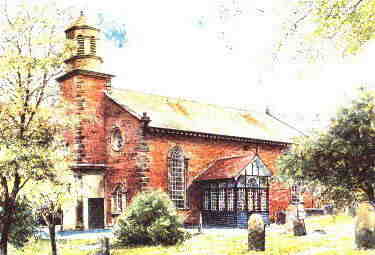
Drawing of St Peter's Church by James Eden
|
|
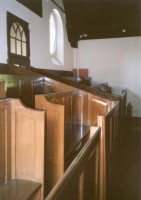
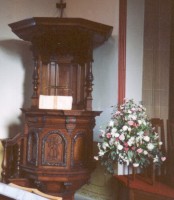
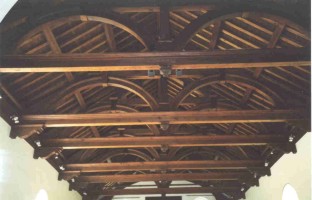
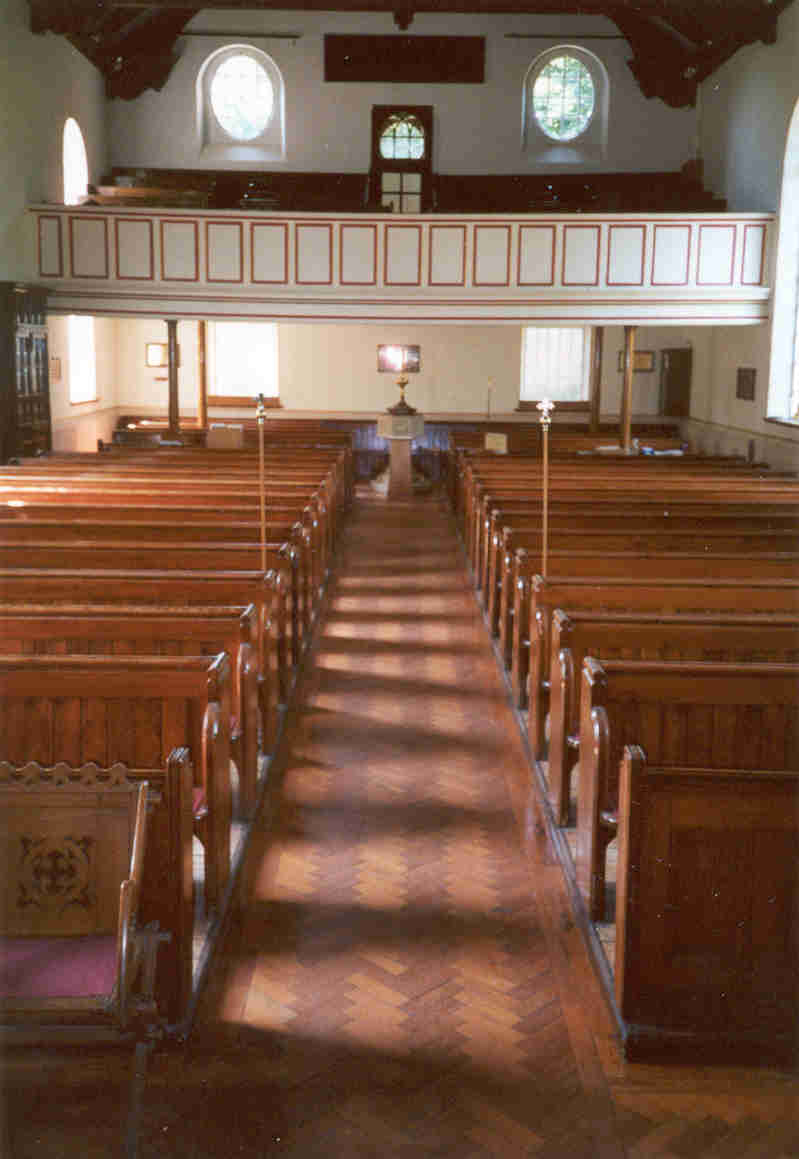
Box-pews in the west gallery; the pulpit; and roof trusses of unusual
design.
|
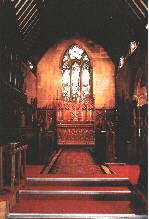
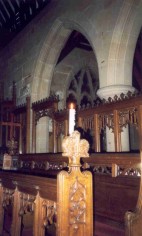
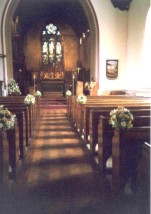
|
The chancel; chancel arch; and nave
|
|
|
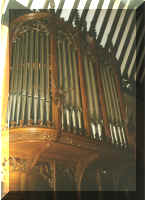
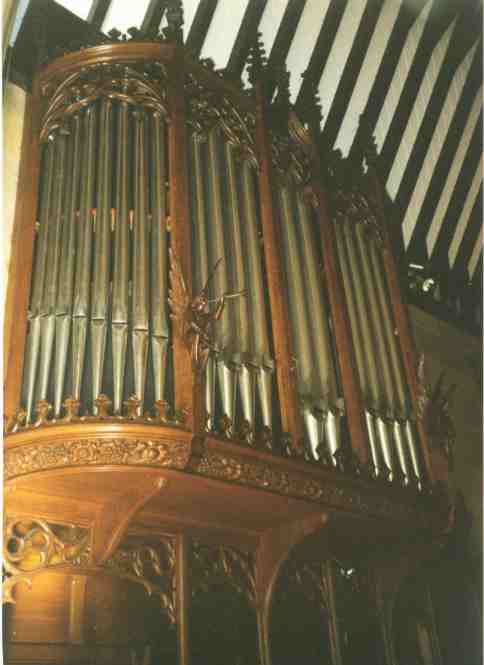
The new organ (2002)
|
|
|
The Church
is not the first Church dedicated to St Peter to stand in Formby.
The title 'The Ancient Chapelry of Formby, St Peter' reminds us
that a chapel existed in Formby from early times - in what was a
detached part of the ancient parish of St Mary, Walton. The Rector
of Walton is to this day Patron of the living.
The ancient chapel stood close to the sea (on the site of the
present St Luke's Church) and was destroyed in 1739 by a storm.
The decision was made to build a new church on a site further
inland and there is evidence from a parish in Oxfordshire that a
nation-wide levy - by order of 'Letters Pattents' of the King -
was made for this purpose. The total amount collected by this levy
was 1154 pence.
So it is that we have a Georgian Church, with characteristic and
very elegant clear glass windows, dating from 1746. At different
times side galleries were added (the line of which can still be
seen in the plasterwork). Box pews and a pulpit
on the south side of the Church (between the windows) are revealed
in a seating plan of 1767.
The building itself is listed. Its fine Georgian nave was
completed in 1746. An 18th century "Singers Gallery"
with box pews adorns the west end of the nave which is lined with
large, clear, wood traceried windows. Unique semicircular wooden
beam trusses support the roof. A Victorian
chancel was added in 1869.
The styles of nave and chancel complement each other in a most
satisfactory way. John Betjeman once visited the church and
remarked on the effective use of glass.
The major change to the building took place in the 1870's. The old
apsidal east end was removed and the present chancel, sanctuary
and side chapel (The Formby Chapel) added. The style chosen was
neo-Gothic so much in at the time. As a result, the Church has its
contrasting, not to say competing, halves. To stand at the chancel
steps and look first west and then east
makes this point.
The main Altar and the sanctuary panelling were given in memory of
old boys of St Peter's School and members of the choir who had
died in the Great War. The present organ,
installed in 2002, includes pipe work from the War Memorial
instrument of 1949.
Two members of the Formby family of Formby Hall were incumbents of
St Peter's for the major part of the 19th century and monuments to
them are on the west wall of the Formby Chapel.
|
|
|
The above (slightly contradictory) information is borrowed from the
church's web site at
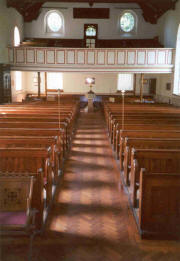
Reaching wall to wall across
the west end of the nave is the Singers' Gallery, so named when it was
built in 1746 because it housed the "Singers" who, accompanied by a
small village orchestra, sang the services and led the singing until the
addition of the chancel in 1869. The construction of the gallery may
even have interrupted the building schedule, such was the new enthusiasm
for congregational singing generated by the evangelical revival. (Who
would design a gallery across a window?).
During the 250th Anniversary of the Consecration of the church in 1997 a
replica group of singers and instrumentalists, sited there, sang psalms
and hymns to music of the period.
The present day choir sings on occasions from the Singers' Gallery -
their ancestral home - from where the sound pervades the whole building
most effectively.
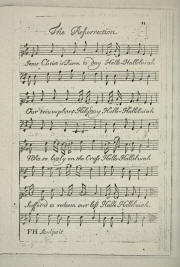
Music is an important
expression of delight and devotional feeling within the worship at
St Peters, where, along with most of Christendom, we also sing the
words of our faith.
The English Hymnal and Hymns Ancient & Modern New Standard form the
staple diet of our sung prayer and praise, alongside Plainsong,
Taize chant, Worship Songs and those popular hymns from the past we
affectionately call 'Golden Oldies'.
The congregation sing the liturgy at the Parish Eucharist, and
Choral Evensong is a happy mix of music for all.
Instrumentalists from our church family and friends enliven major
festivals, and the informal Christmas Orchestra is a feature at our
annual Festival of Lessons & Carols.
|
St Peter's, Freshfield
The oldest in this area, this church
 was built in 1746 to replace a chapel
 which had been abandoned because of
 the encroachment of the sea. It has an
 average Sunday morning family service
 congregation of 220. There are 188
 people on its Electoral Roll, 156 of
 whom live within the parish. The
 present incumbent is Canon Norman
 Carter. He has no full-time assistants
 but is helped by one other priest and
 two lay-readers.

 St.Peter's is quiet and peaceful,
 You want to whisper there.
 A stained glass window towers above the altar.
 A gold cross stands proudly in front.
 The lectern is a carved eagle.
 Banners hang silently round the church
 A star light glitters in the chapel of rest.
Louise and Sandra (aged 10)in 1984
From: http://www.bbc.co.uk/history/domesday/dblock/GB-328000-408000/page/10
|
The information below was supplied by Philip
Lowe, choir master and one time church warden
|
|
I believe the FORMBY church to
which you refer is St. Peter's in Green Lane,
Formby, otherwise known as the Ancient Chapelry of
St. Peter, Formby.
[ . . . ] The old building which
it replaced stood on the site
stood on the site of the
present St Luke's chirch and dated back to ca.1200.
was built by or connected with the monks of Cockersand Abbey on the Ribble estuary. From
some old accounts I know it had bells and box pews
which were rented, including a gallery. No
information about the design of the church has yet
been found by present members of the congregation.
A previous church stood on the site of St Luke's
but was overcome by a sandstorm. The
congregation took some of the stone and the sundial
and coat of arms and went inland away from the
storms to build St Peter's.
St. Luke's was provided for the
increasing population
and for the anticipated visitors to the seaside
resort, a hotel
and promenade having been recently built. The
resort, however, never
"took off" but
the church is thriving.
I believe that the previous site
of St Peter's was reused at a later date upon
which to build St Luke's, St Peter's having been
rebuilt further inland, presumably to reduce the
risk of a similar occurrence of flooding, or
worse. This would seem to follow from what you
said about St Luke's being built to accommodate
increased numbers of worshippers, rather than
initially being a private chapel.
St. Luke's have a website http://stlukes.merseyside.org
|
|
ACCESS |
| Map reference :
The church is located at OS grid reference
SD2992708273 (Lat/Lon 53.566364,-3.059528). You can
see this on maps provided by:
|
|
Please see our
Home Page
for important copyright notice |

|
|

|
|
|

|
|
|
|
|
SEARCH THIS SITE |
|
|
This
site has been constructed by, and remains the copyright of,
its authors,
Edwin and Sheila Macadam,
Shelwin, 30, Eynsham Road, Botley,
Oxford OX2 9BP
|
|
| ©
July 2001 -
|
|
 pegman to centre of map to show picture)